


Artist of excellence : thoughts of Vittorio Vettori On M.B. Coppi
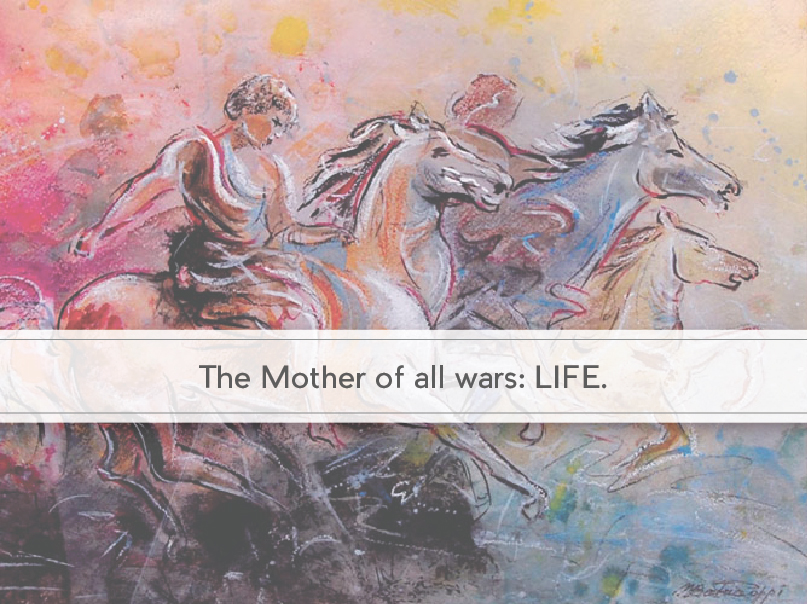
 The profession of arms is the great pictorial theme of Maria Beatrice, and exists as the expressive (and expressionistic) formula of an internal tension akin to what which made Ermanno Olmi’s independent masterpiece so unique and incomparable. In Olmi’s film the hero Giovanni dei Medici (known as Bande Nere) slowly rises to the dignity of a Christus patiens through a slow and paradigmatic spiritual evolution, as has been described with remarkable penetration by a young writer, Marco Lodi, in his reviw published in the weekly, “Diario”. Unbelievably, Maria Beatice had prefigured Olmi’s film in her figurative art by projecting onto her own ancestor, Lucantonio (who had been bothe friend and lieutenant to Giovanni delle Bande Nere), the same Christlike identity as that of the Captain of the Medici. In the eighties Lino Rossi wrote on the Milan daily newspaper, “Il Giorno” : “The last works by Mara Beatrice Coppi represent global battles and crucifixions that involve heaven and earth, and the sea in a battle betweenn sldiers and a ship which is as absurd on the rational plane as it alive and real on the emotional one”. When I think again and reflect on the dream-like exhibition of Maria Beatrice’s art I am always accompanied by Sergio in his inimitable and authenthic role as Mentor, ever ready to partecipate and interact with all the friendly enthusiasm of his generous nature. Sergio begins by nothing the obvious but never sufficiently highlighted consonance between the “Profession of Arms” and Maria Beatrice Coppi’s literary and artistic works, and the cinematographic masterpiece by Ermanno Olmi. He then walks around the dream-like non-location Exhibition, and effortlessly but without ostentatious technical references, analogies and connections helps me to perceive in Maria Beatrice’s art the essential tension that connects the typically Emilian epic element of the officina ferrarese ( so close to the inspiration of Roberto Longhi) with the modern Christology of Roualt, the valuable influence of Arturo Martin, and the no less intense vigour of Lorenzo Viani; the polychromatic musically and the ascension of Henri Matisse and the essential neo-Etruscan and neo-Greek rigor of Marino Marini and Francesco Messina; the disquieting monumental character of Mario Sironi and that without shadow or uncertainly of Emilio Greco.
No Comments